Sustainable Rugs in South Africa: The Real Carbon Footprint of Wool vs Synthetic Rugs
If you’re searching for sustainable rugs in South Africa, you’ve probably noticed that every fibre claims to be the eco-friendly one. Wool is marketed as natural. Polypropylene is marketed as recyclable. Recycled PET is marketed as circular. All three claims are true — and none of them, on their own, tells you which rug actually has the lower environmental impact.
There is no single “greenest” rug fibre. A wool rug isn’t automatically more sustainable because it comes from sheep. A polypropylene rug isn’t automatically irresponsible because it starts life as a fossil-based polymer. The real carbon footprint of a rug is decided across its full life cycle — raw material, manufacture, transport, years of use, maintenance, and what happens when it’s finally retired.
For South African homeowners, interior designers, architects and hospitality developers specifying at scale, that’s the distinction worth understanding before you buy. This guide breaks down what the data actually shows, and which sustainable rug options in South Africa suit which spaces.
Why “Eco-Friendly” Labels Don’t Tell the Whole Story
The homeware industry uses “natural,” “green,” “recyclable” and “sustainable” fairly loosely. These words are useful shorthand, but a rug’s real footprint is shaped by far more than its fibre name:
- Fibre type
- Rug weight and pile density
- Construction method
- Dyeing and finishing processes
- Backing materials
- Country of manufacture and transport distance
- Cleaning and maintenance requirements
- Expected service life
- End-of-life route
A lightweight synthetic rug that lasts three years behaves very differently, environmentally, from a dense wool rug that lasts three decades. A wool rug with a higher upfront footprint can become the more sustainable option over time simply by avoiding repeat replacement.
At Woven Bliss, we base rug recommendations on application and verified performance data — not marketing language.
How Rug Carbon Footprints Are Actually Measured
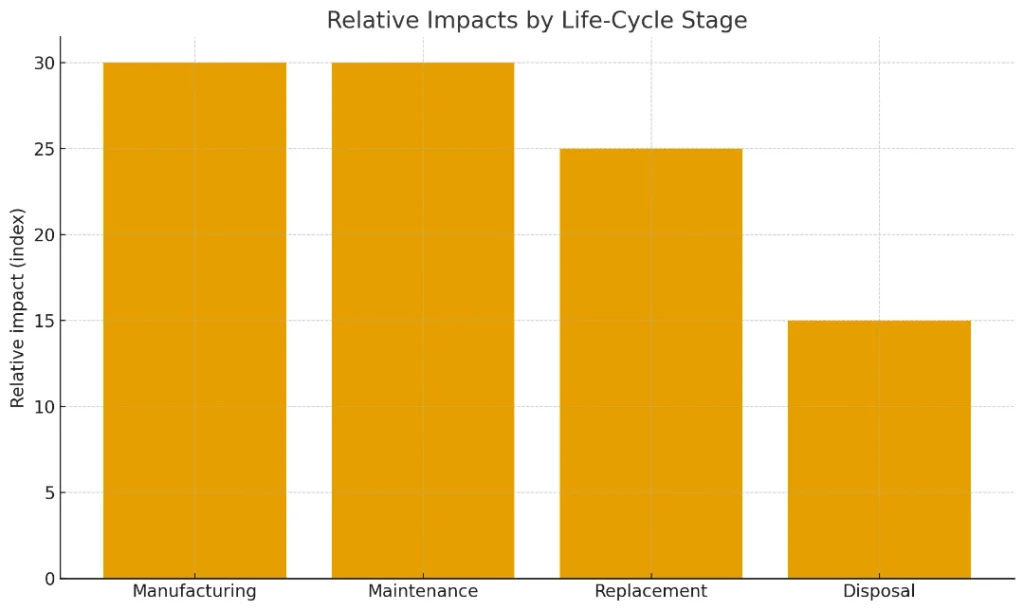
The most credible way to compare sustainable rugs is a Life Cycle Assessment (LCA), often backed by an Environmental Product Declaration (EPD). These break a product’s life into stages:
A1–A3 — Raw materials and manufacturing (“cradle-to-gate”): extraction or farming, processing, yarn spinning, dyeing, manufacture.
A4–A5 — Transport and installation: factory to site, and installation impacts.
B2 — Maintenance: vacuuming, washing, hot-water extraction and other care over the rug’s life.
B4 — Replacement: how often the rug needs replacing across a building’s lifespan.
C1–C4 — End-of-life: removal, transport, landfill, recycling or recovery.
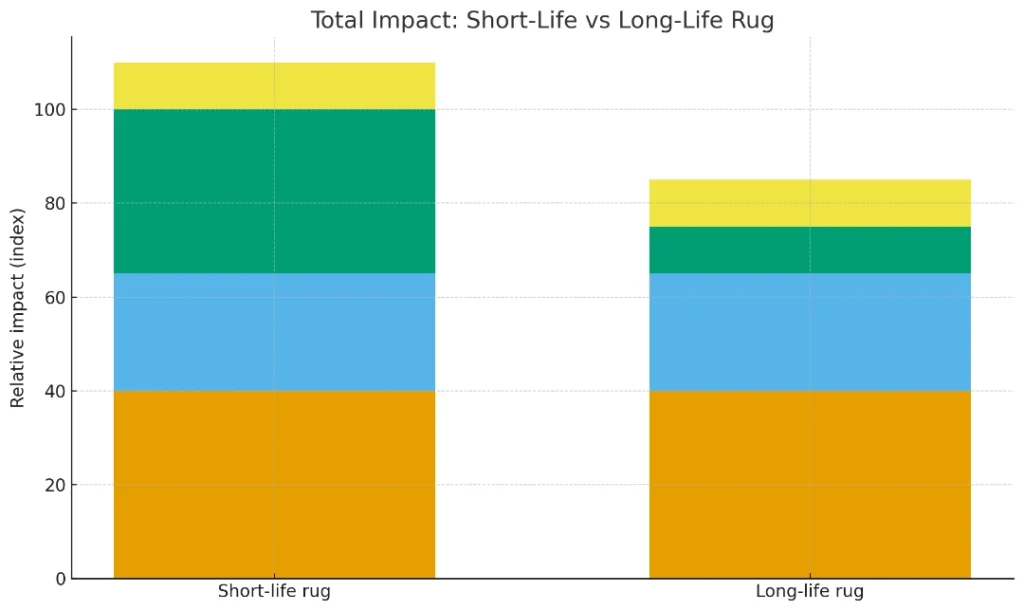
This matters because the lowest-carbon rug at the factory gate is not always the lowest-carbon rug over 10, 20 or 30 years of actual use — which is the number that matters for a considered, long-term interior.
Wool vs Polypropylene vs Recycled PET: The Carbon Comparison
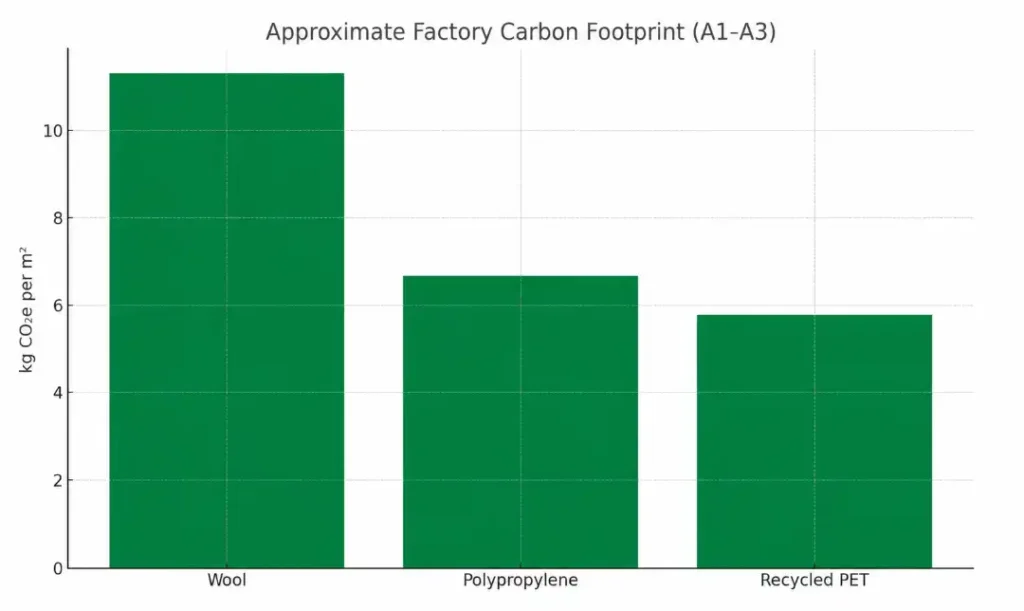
Public EPDs and published LCA studies generally show synthetic fibres performing well at the cradle-to-gate stage. Polypropylene, recycled PET and nylon can post lower A1–A3 emissions per square metre than wool, largely because wool carries the burden of enteric methane from sheep farming.
| Rug Fibre | Approx. Cradle-to-Gate Footprint | Longevity | End-of-Life |
|---|---|---|---|
| Wool | Higher — often ~11 kg CO₂e/m² in broadloom examples | Very high, when well made and maintained | Pile is biodegradable; backing and finishes still matter |
| Polypropylene | Often lower — ~6–7 kg CO₂e/m² in some carpet tile examples | Moderate to high | Recyclable where PP recycling streams exist |
| Nylon | Often ~5.5–7.3 kg CO₂e/m² depending on construction | High in commercial-grade builds | Recycling possible where take-back schemes exist |
| Recycled PET | Often competitive at production stage | Moderate to high | May be recyclable or downcyclable, depending on local infrastructure |
Treat these as directional, not absolute — weight, backing, dyeing and construction all shift the number. The takeaway that matters for buyers: a synthetic rug may start with a lower embodied footprint, but a well-made wool rug can overtake it once you account for a much longer service life.
The Hidden Carbon Cost of Wool Rugs
Wool’s main climate cost is enteric methane, produced during sheep digestion — this is why wool looks carbon-intensive when measured only from farm to factory gate.
But wool earns that footprint back through performance:
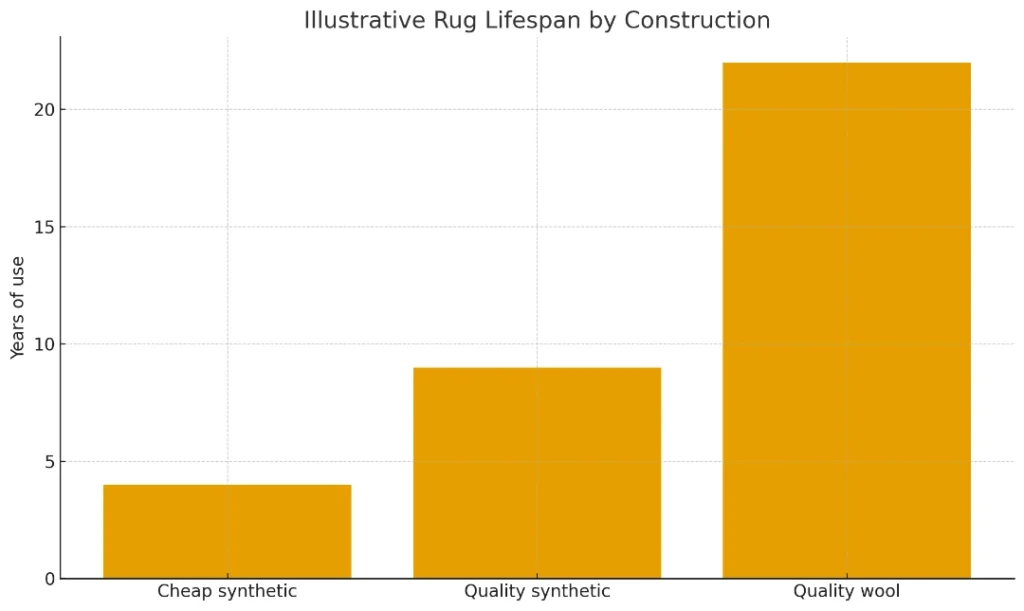
Exceptional longevity. A dense, well-made wool rug can remain in use for decades — often outlasting several synthetic replacements in the same room.
Natural resilience. Wool’s crimp and fibre memory let it recover from compression and foot traffic better than lower-grade synthetics.
Soil resistance. Wool naturally resists certain dirt types and holds its appearance with correct care.
Biodegradability. The wool pile itself biodegrades under suitable conditions — a genuine end-of-life advantage over plastic-based fibres, though backing materials still need consideration.
A wool rug that lasts 25–30 years can have a stronger whole-life case than a cheaper synthetic replaced every five to ten. For interiors where durability, repairability and long-term value matter, wool remains one of the strongest sustainable rug choices available in South Africa.
Explore Woven Bliss Wool Rugs
Where Synthetic Rugs Genuinely Perform Well
Synthetic rugs are often judged harshly for being fossil-derived — a fair criticism, but only half the picture. Polypropylene, PET and nylon can be durable, colourfast, stain- and moisture-resistant, and more affordable than premium natural fibres. In South African homes, they’re especially well suited to outdoor spaces, family rooms and high-traffic areas.
Strengths:
- Often a lower initial cradle-to-gate footprint than wool, at moderate pile weights
- Solution-dyed polypropylene handles patios, poolside areas and covered verandas better than most natural fibres — resisting moisture, rot and UV
- Easier day-to-day cleaning, useful for homes with kids or pets
- Improving circularity, as recycled content and local reclamation programmes grow in South Africa
Weaknesses:
- Fossil-based inputs unless recycled
- Microfibre shedding into indoor dust and air during use and cleaning — an impact not yet captured in most standard carbon assessments
- Real-world recycling depends on mixed materials, adhesives and local infrastructure actually supporting it
Synthetic rugs aren’t the villain — they need to be chosen for the right application, used properly, and kept in circulation as long as possible.
Explore Woven Bliss Outdoor Rugs
Maintenance Changes the Whole Carbon Picture
A rug’s footprint doesn’t stop at the factory door. Vacuuming, washing, hot-water extraction, chemical cleaners, drying and transport to professional cleaners all carry a cost — and a rug that wears out or loses its appearance early forces an earlier replacement, which usually outweighs the original manufacturing footprint entirely.
To reduce whole-life impact:
- Match the fibre to the room correctly from the start
- Use a rug pad to reduce movement and abrasion
- Vacuum regularly, on the correct setting
- Treat spills immediately rather than letting stains set
- Avoid harsh chemical cleaners where possible
- Rotate rugs for even wear
- Repair or rebind rather than replacing prematurely
The most sustainable rug, in practice, is the one that stays beautiful and functional for the longest possible time.
Microplastics: The Sustainability Issue Most Comparisons Miss
Carbon footprint isn’t the only environmental consideration. Synthetic rugs can shed microfibres during everyday use, which may enter indoor dust, air, waterways or waste systems. This is one reason natural fibres remain the preferred choice for bedrooms, lounges and other spaces where indoor air quality matters.
If you do choose synthetic, reduce the risk with:
- A HEPA-filter vacuum
- Denser, more stable constructions
- Rug pads to reduce friction
- Less frequent machine washing
- Keeping outdoor rugs outdoors
South Africa’s Role in Circular Rug Design
Because many imported rugs travel long distances, local production, local finishing and local reclamation genuinely change a rug’s true footprint. South African flooring manufacturers have already demonstrated circularity through polypropylene reclamation and post-industrial material recovery — keeping valuable materials in use rather than in landfill.
For architects and specifiers working toward Green Star SA or similar sustainability targets, the most defensible choice is usually the one backed by documentation:
- Verified EPDs, where available
- Recycled-content declarations
- Technical data sheets and fire certification for commercial use
- Take-back or reclamation options
- Local repair, cleaning or refurbishment pathways
Which Sustainable Rug Suits Your Space?
Long-term residential interiors — living rooms, bedrooms, formal lounges, heritage homes: dense wool or wool-blend rugs, chosen for comfort, durability and long-term value.
Outdoor living areas — patios, poolside, braai areas, coastal homes: polypropylene or recycled polypropylene, built for moisture, UV and heavy sun exposure.
Commercial and hospitality projects — hotels, lodges, offices, retail, restaurants: fibre selected against traffic levels, cleaning demands, fire certification and realistic replacement cycles.
Low-microplastic indoor environments — bedrooms, wellness-led interiors: wool, sisal, hemp or seagrass, matched to the room’s moisture and traffic conditions.
Wool vs Polypropylene: Which Is Actually More Sustainable?
It depends entirely on how long the rug lasts and how it’s used — not on the fibre name alone.
A polypropylene rug used outdoors for years and then responsibly recycled is a sensible sustainable choice. A wool rug used indoors for decades, properly maintained and kept out of landfill, is equally responsible.
The better question isn’t “which fibre is always better?” It’s: which rug will perform best in this specific space, for the longest realistic period of time?
Final Thoughts: The Greenest Rug Is the One That Lasts
There’s no universal winner between natural and synthetic. Wool carries a higher upfront footprint from agricultural methane but offers exceptional durability, comfort and biodegradability. Polypropylene, recycled PET and nylon often start with lower manufacturing emissions and strong practical performance, but depend on plastic-based materials and can shed microplastics.
Maintenance, replacement and disposal can outweigh either fibre’s starting footprint entirely. For South African homes and design projects, the most sustainable rug is one that:
- Suits the application
- Performs well in its environment
- Is made responsibly
- Is maintained correctly
- Lasts for years, not seasons
- Has a realistic end-of-life route
At Woven Bliss, we help homeowners, designers and specifiers choose sustainable rugs in South Africa that balance beauty, performance, durability and genuine environmental responsibility.
Book a custom rug consultation →
Frequently Asked Questions
Are wool rugs more sustainable than synthetic rugs?
Wool rugs can be more sustainable when well made, properly maintained and used for many years. Wool has a higher upfront carbon footprint due to methane from sheep farming, but its sustainability advantage comes from durability, longevity and biodegradability.
Are polypropylene rugs eco-friendly?
Polypropylene rugs often have a lower cradle-to-gate carbon footprint than wool and perform well outdoors and in high-traffic spaces. They’re plastic-based and can shed microfibres, so a realistic recycling or reuse pathway matters.
What is the most sustainable rug material available in South Africa?
There’s no single answer. Wool, sisal, hemp, seagrass, recycled PET and polypropylene can all be responsible choices in the right setting — the most sustainable rug is usually the one that lasts longest in its intended space.
Do synthetic rugs release microplastics?
Yes, synthetic rugs can shed microscopic fibres during use, vacuuming and cleaning. Shedding levels depend on fibre type, construction quality and maintenance.
Which rug is best for outdoor use in South Africa?
For patios, poolside areas and braais, solution-dyed or recycled polypropylene is usually the most practical choice — it handles moisture, UV and regular cleaning better than most natural fibres.
How can I reduce the carbon footprint of my rug?
Choose the correct fibre for the space, buy quality, maintain it properly, use a rug pad, repair rather than replace where possible, and consider resale, donation or recycling at end of life.