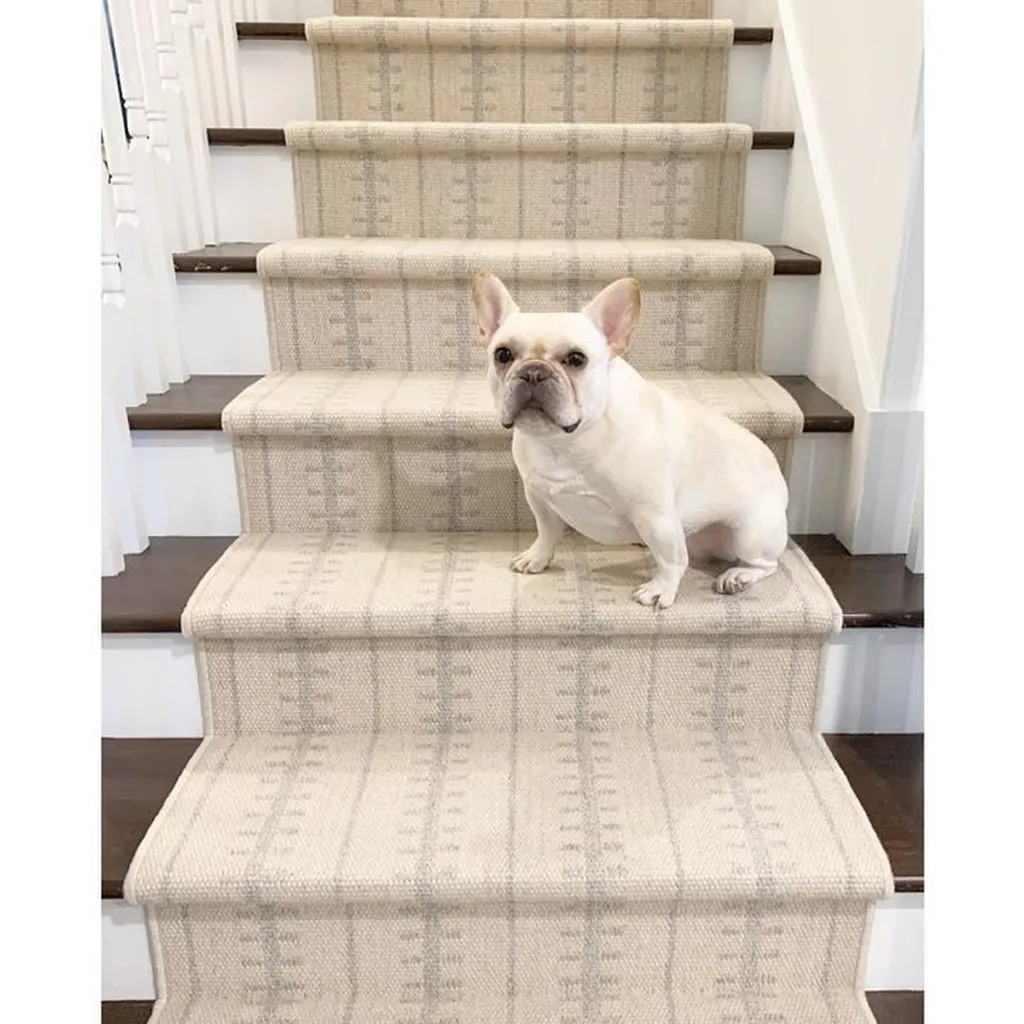
A Professional Guide to Installing Stair Runners & Decorative Stair Rods
Introduction
A beautifully fitted stair runner transforms a staircase — adding warmth, texture, and a touch of luxury.
This guide provides a professional, step-by-step process for fitting stair runners, along with handmade decorative stair rods and brackets.
All Woven Bliss rods and brackets are custom-made to order — each length cut precisely, finials shaped by hand, and finished to your chosen specification.
Runners are cut and overlocked to match your staircase length, ensuring a perfect fit.
Whether you have a straight flight, a curved sweep, or a winder staircase with a bend, this guide will help you measure, prepare, and install with confidence.
Tools & Materials
| Tool / Material | Purpose | Notes |
|---|---|---|
| Drill | Drill hole | Use appropriate drill bit |
| Tape measure | Accurate measurements | Use a flexible type for curved stairs |
| Screwdriver | Securing brackets | For your decorative stair rods |
| Stair tool / carpet tucker | Smooth and tighten runner | Essential for neat folds |
| Staple gun or hammer & tacks (optional) | Fixing runner | For wooden stairs |
| Underlay (optional) | Cushioning | 3 mm or 5 mm crumbed rubber recommended |
| Carpet gripper (optional) | Holding runner edges | For enhanced grip |
| Adhesive or high-strength double-sided tape | Alternative fixing method | For concrete stairs |
| Handmade stair rods & brackets | Decorative finishing | Cut to order with custom finials |
Measuring Your Staircase
Accurate measurement ensures your stair runner and rods fit perfectly.
Step 1 – Measure One Step Unit
- Measure the tread depth (horizontal section).
- Measure the riser height (vertical face).
- Add both together to determine the “unit rise.”
- If there’s a nosing, measure the wrap distance under it.
Step 2 – Calculate Runner Length
(Tread depth + Riser height)×number of steps(\text{Tread depth + Riser height}) \times \text{number of steps}(Tread depth + Riser height)×number of steps
Add 10–15 % extra to allow for trimming and adjustments.
Include any landings or turns in your total.
Step 3 – Determine the Stair Runner Width
- Measure total stair width.
- Subtract equal margins (reveals) on both sides — typically 50–80 mm per side.
- The result is your runner width.
- Each rod should be roughly 30–50 mm longer than the runner width to fit between bracket cups.
Step 4 – Mark the Centre Line
Mark the centre on each tread and riser to maintain consistent alignment during fitting.
Preparing the Stairs
- Clean thoroughly and check for uneven steps or protruding nails.
- Install underlay (optional): cut each pad slightly narrower than the runner width and secure it.
- Install carpet grippers (optional): along the back of each tread or under nosing.
- Dry-fit your runner to confirm visual alignment before final fixing.
Fitting the Stair Runner (Straight Stairs)
Method Options
- Staple gun or tacks – most secure for timber stairs.
- High-strength double-sided tape – ideal for smooth concrete or finished wood.
- Carpet adhesive – clean finish, permanent bond.
- Tack strips – traditional professional method.
Step-by-Step
- Start at the top:
Align the stair runner along your centre marks. Fix beneath the top nosing or top riser using your chosen method. - Work down each step:
- Tuck runner tightly into the crease between tread and riser using your stair tool.
- Secure the base of each riser (staples ~ 75 mm apart).
- Smooth over the tread and repeat down the flight.
- Finish neatly:
At the bottom step, fold excess under the last tread and secure for a clean edge.

Fitting on Rounded or Winder Staircases
Curved or winder staircases require additional care — each tread differs in width and angle.
Step 1 – Identify Stair Type
- Winder stairs: turn at 90° or 180°, fan-shaped steps.
- Curved / helical stairs: continuous smooth curve.
- Spiral stairs: circular around a post.
Step 2 – Establish the Flow Line
- Mark a visual centre line down the curve using string or flexible tape.
- This line guides the runner’s path for even reveals.
Step 3 – Measure Each Step Individually
- Record inner edge width, outer edge width, riser height, and tread depth.
- The runner may need to taper slightly so the visible edge looks uniform around the curve.
Step 4 – Create Templates (Recommended)
- Use craft paper or fabric to make templates for each curved tread.
- Label each clearly (e.g., “Curve Step 1”).
- Test-fit these before cutting your runner.
Step 5 – Fit the Stair Runner
- Start from the top of the bend.
- Align along your flow line; adjust slightly at each step.
- Secure each tread and riser individually.
- For tight curves, make tiny relief cuts in the backing only (not the pile) to allow the runner to bend smoothly.
- Continue until the curve is complete, trimming and tucking neatly at the base.
Pro Tip: Avoid thick underlay on tight bends — it may cause bulging or wrinkling.
Installing Decorative Stair Rods & Brackets
Your Woven Bliss rods and brackets are decorative and hand-finished; they enhance style but do not hold the runner in place.
Step 1 – Position Brackets
- Place one bracket on each side of the runner at the tread/riser junction.
- Mark screw holes.
- For curved or winder stairs, angle the brackets parallel to the runner edge, not the stair edge, so they follow the visual flow.
Step 2 – Secure Brackets
- Drill pilot holes if needed (especially in hardwood).
- Screw the brackets firmly but avoid overtightening.
Step 3 – Insert Rods & Finials
- Slide your custom rod (cut to exact width for each step) through both brackets.
- The rod should rest gently against the carpet pile.
- Attach finials and tighten set screws.
Step 4 – Polish & Inspect
- Wipe rods and brackets with a soft cloth.
- Check that all rods are level and evenly spaced.
Finishing Touches & Maintenance
- Vacuum weekly with brush bar off.
- Spot clean immediately using gentle carpet shampoo.
- Polish brass or stainless-steel rods periodically.
- Every few months, remove rods to clean beneath and check fittings.
Troubleshooting
| Issue | Cause | Solution |
|---|---|---|
| Runner drifted off centre | Uneven tucking / inaccurate line | Re-align using centre marks |
| Wrinkles on curved stairs | Overly thick underlay / no relief cuts | Trim underlay or add small backing slits |
| Visible gaps at edges | Uneven reveals | Adjust bracket spacing or runner angle |
| Rod misalignment | Brackets fixed to stair edge, not runner edge | Re-align to follow runner |
| Adhesive not bonding | Dust or paint residue on stair | Clean and reapply adhesive |
Summary of Best Practices
- Measure twice, cut once — especially for winder steps.
- Always dry-fit before final fixing.
- Keep the runner taut but not stretched.
- On curves, let the runner flow naturally.
- Use brass polish or microfibre cloths for long-term rod maintenance.
Call to Action
Enhance your staircase with handmade details that last a lifetime.
Order your custom stair runner, underlay, and decorative brass, stainless-steel, or mild-steel rods from Woven Bliss South Africa — locally crafted, made-to-measure, and finished to perfection.
Explore our collection: https://www.wovenbliss.co.za/product-category/rugs-and-runners/stair-runners/