The complete room-by-room rug size guide for South African homes
| Rug Size Guide | Best suited for | Room type |
| 160 x 230cm | Apartments / Small Nooks | Studio / Study |
| 200 x 300cm | Standard Living Area | 3-Seater Sofa Set |
| 300 x 400cm | Large Open-Plan / King Bed | Formal Lounge / Master |
| 400 x 500cm+ | Grand Spaces / Bespoke | Commercial, Hospitality / Luxury Estates |
Buying a rug is the easy part. Choosing the right size is what makes a space feel calm, balanced, and genuinely finished. A rug that’s too small can leave beautiful furniture looking disconnected; the right proportions instantly elevate the room—without changing anything else.
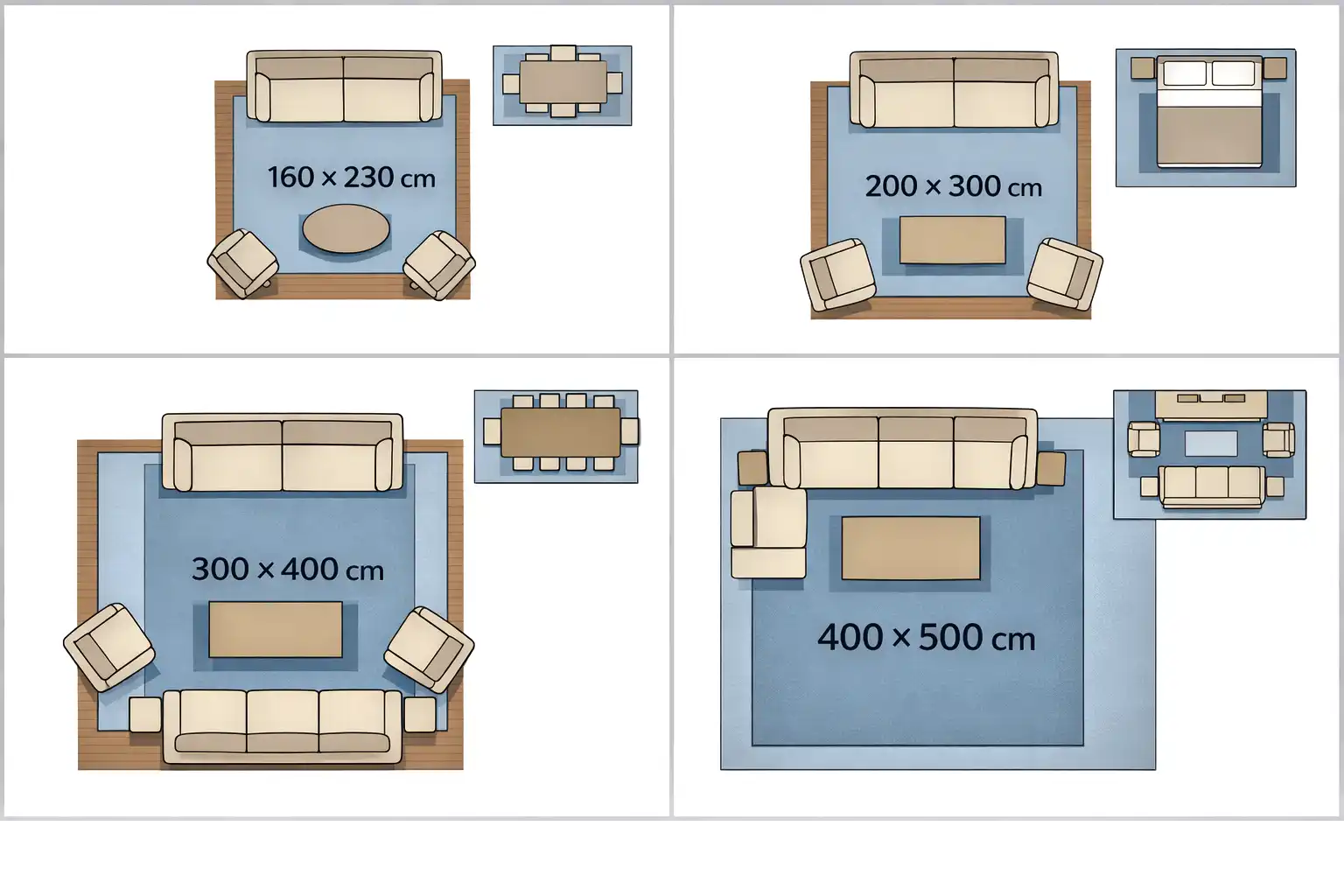
This rug size guide is written in metric and built around sizes South Africans actually buy: 160 × 230 cm, 200 × 300 cm, 300 × 400 cm, and 400 × 500 cm, plus runner sizing for passages and stairs. You’ll also learn when made-to-measure runners or a bespoke, larger-scale rug are the smarter choice for open-plan living and luxury interiors.
If you’d like tailored advice, book a free Zoom design consultation for all products:
https://www.wovenbliss.co.za/free-consultation/
For bespoke rugs and runners, arrange a specialised consult:
https://www.wovenbliss.co.za/made-to-order/
Start here: the three rules designers use every time
1) Anchor the furniture
A rug should connect your key pieces—sofa, chairs, bed—rather than sit like a floating island.
2) Keep a visible border
Leave a frame of floor around the rug so the room breathes and looks intentional.
3) When in doubt, go bigger
In most rooms, sizing up creates a more premium result—especially in open-plan spaces.
Your standard rug sizes: what each one is best for
160 × 230 cm
Best for: compact living rooms, apartments, reading corners, small dining areas, layered looks, or as a feature rug in a bedroom.
200 × 300 cm
Best for: the majority of living rooms, queen bedrooms, medium dining rooms, and home offices. Often the most versatile size for anchoring a seating area without overpowering the room.
300 × 400 cm
Best for: larger lounges, open-plan zones, king bedrooms, bigger dining tables, and rooms where a high-end, grounded feel is desired.
400 × 500 cm
Best for: expansive open-plan living, formal lounges, hospitality-style layouts, and premium interiors where scale is part of the design.
Practical advice: if your room is open-plan—such as lounge flowing into dining or kitchen—jump one size up from what you initially think you need.
Shop area rugs | Discover organic fibre rugs
Living room rug sizing: three layouts that actually work
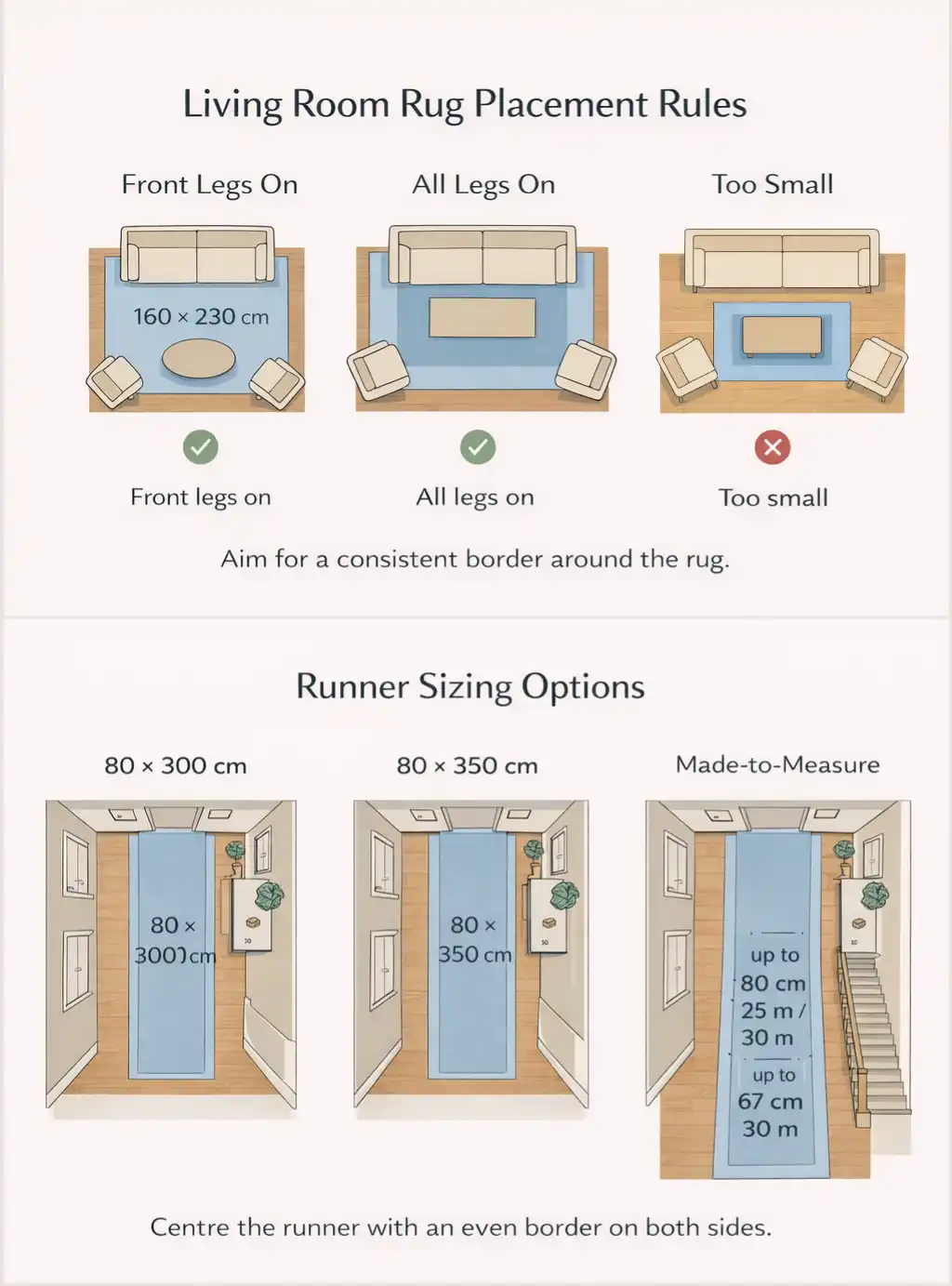
Layout A: front legs on
Place the rug so the front legs of your sofa and chairs sit on the rug.
- Works well with 200 × 300 cm in many homes.
- Larger lounges often suit 300 × 400 cm or 400 × 500 cm.
Layout B: all legs on
All furniture legs sit fully on the rug. This is the designer show-home look.
- Typically requires 300 × 400 cm or larger, depending on seating scale.
Layout C: coffee table only
While some use a small rug just for the coffee table, we generally recommend avoiding this unless the space is extremely restricted, as it can make a room feel smaller than it actually is.
Open-plan tip: use one large rug to zone the lounge area rather than a small rug that breaks the flow.
Architectural Digest – Rug placement rules designers swear by
https://www.architecturaldigest.com/story/rug-placement-rules
Dining room rug sizing: the chair rule
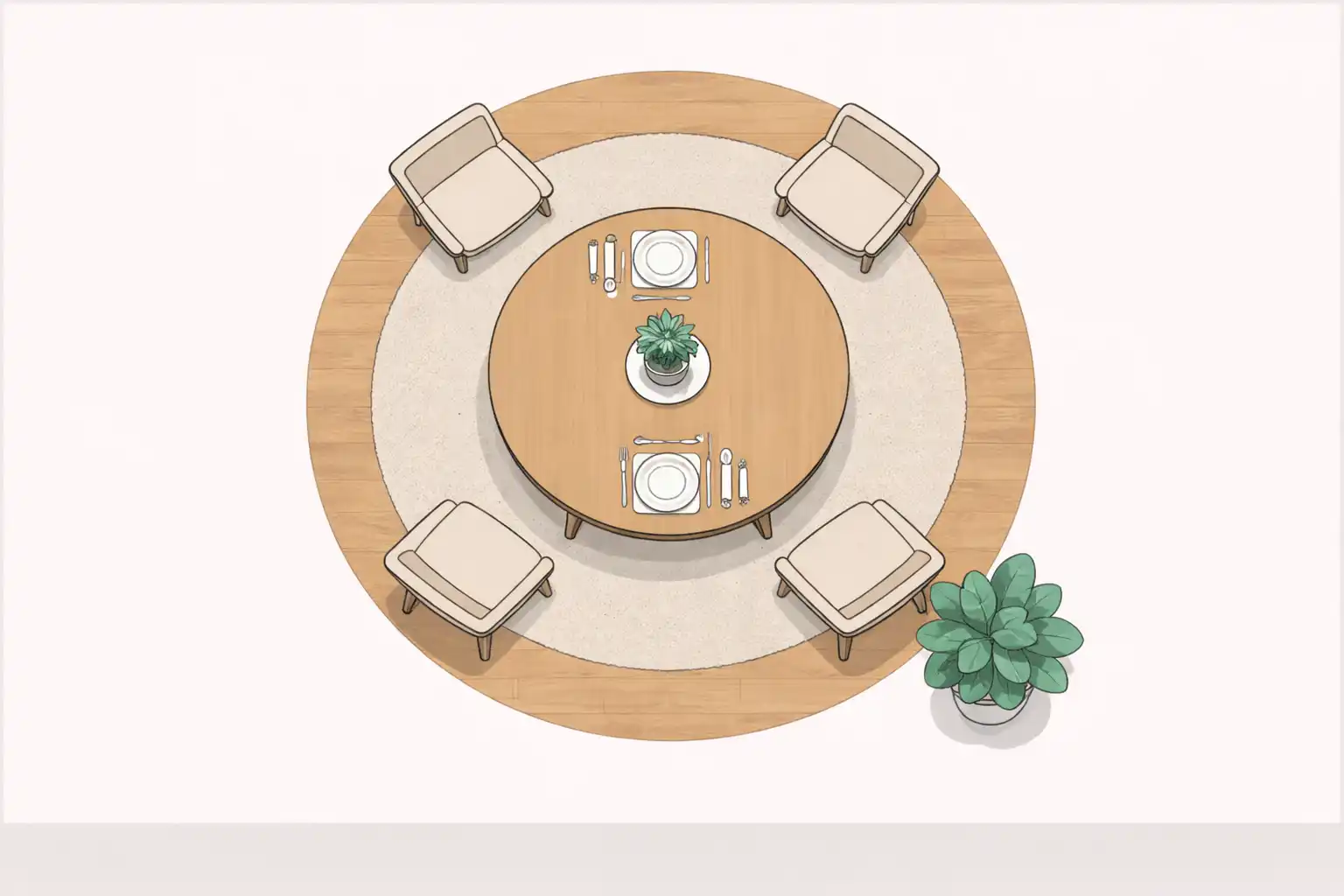
A dining rug must be large enough that chairs stay on the rug when pulled out. If chair legs drop off the edge, the layout feels awkward and edges can wear prematurely.
- Rectangular tables pair best with rectangular rugs.
- In high-traffic dining areas, consider constructions and materials that manage movement well, and use a quality underlay to stabilise.
Find durable area rugs for dining rooms
Bedroom rug sizing: comfort plus balance
Option A: rug under the bed
A rug under the bed should extend beyond the sides and foot so your first step is soft rather than cold tiles.
- Queen rooms often work well with 200 × 300 cm, depending on bedside tables and room width.
- Larger rooms or king beds often look best with 300 × 400 cm.
Option B: rug partially under the bed
If you prefer a lighter look, place the rug under the lower two-thirds of the bed so it frames the foot area. This maintains softness underfoot and keeps the room feeling open.
Option C: runners beside the bed
For maximum practicality or narrower rooms, runners along each side of the bed deliver a neat, hotel-like finish.
Shop soft, tactile area rugs for bedrooms | Organic fibre rugs for layered bedrooms
A dining rug must be large enough that chairs stay on the rug when pulled out. If chair legs drop off the edge, the layout feels awkward and edges can wear prematurely.
- Rectangular tables pair best with rectangular rugs.
- In high-traffic dining areas, consider constructions and materials that manage movement well, and use a quality underlay to stabilise.
Find durable area rugs for dining rooms
“Tip: Add at least 60–70 cm to each side of your table measurements. This ensures that when a guest pulls their chair out to sit, the back legs stay on the rug.”
Hallways, passages, and stair runs: runner sizing made simple
Your standard runner sizes
- 80 × 300 cm — ideal for shorter passages, small foyers, and landings.
- 80 × 350 cm — ideal for longer hallways and corridor runs.
Made-to-measure runners: your advantage
For long halls, stairs, or unusual layouts, made-to-measure creates a seamless, built-in look:
- Up to 80 cm × 25 m
- Up to 80 cm × 30 m
- Up to 67 cm × 30 m
- Custom widths and lengths available
These options are especially valuable in older homes, non-standard passages, and boutique interiors where off-the-shelf sizes never fit perfectly.
Runner placement rules
- Centre the runner and keep an even border of floor on both sides.
- Avoid runners that stop randomly mid-hall; a longer run usually looks more intentional.
- For safety and longevity, pair runners with an appropriate underlay, particularly on tile or smooth floors.
Shop carpet runners | Shop stair runners
Preventing slips and falls in the home (NHS)
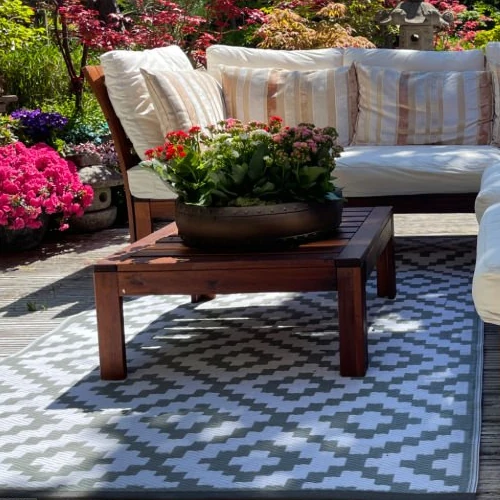
For covered patios, verandas, and outdoor flow areas:
Explore outdoor rugs for patios and verandas
When standard sizes aren’t enough: bespoke rugs, often 5 × 6 m and larger
In open-plan homes, boutique hospitality, or statement interiors, standard sizing can feel like a compromise. Bespoke rugs—often 5 × 6 m and above—deliver a transformative effect and a precise fit.
Bespoke projects involve:
- Scale and shape, including custom outlines and proportions
- Pattern development and colour mapping
- Material selection and texture—hand-tufted, hand-knotted, or handwoven
- Lead times and installation considerations
Made-to-order rugs & runners (bespoke sizing)
A five-minute measuring checklist
Before buying, measure these in centimetres:
- Room length × width
- Sofa length and distance of chairs from the coffee table
- Dining table length × width, and clearance behind chairs
- Bed size and desired clearance at foot and sides
- Hallway length and usable width, excluding door swing
Practical tip: use masking tape on the floor to outline your intended rug size. It prevents costly mistakes.
Which? (UK) – How to measure a room properly
https://www.which.co.uk/reviews/carpets-and-flooring/article/how-to-measure-a-room-a4wJQ1Q5Q6tZ
Ready for a perfect fit?
Book your free Zoom consultation
Arrange a bespoke rug or runner consultation
What’s the most versatile rug size?
For many homes, 200 × 300 cm is the most versatile size for living rooms and bedrooms. In larger or open-plan spaces, 300 × 400 cm or 400 × 500 cm usually creates a more grounded, premium look.
Is a bigger rug always better?
Not always—but it’s often the difference between a room that feels “okay” and one that feels professionally styled. If your furniture looks disconnected, sizing up helps anchor the layout and improves overall proportion.
How do I choose the right rug size for a dining room?
Use the chair rule: the rug should be large enough that chairs stay on the rug when pulled out. If chair legs drop off the edge, it feels awkward and can wear the rug edges faster.
What runner sizes do you offer?
Our standard runner sizes are 80 × 300 cm and 80 × 350 cm.
Do you offer made-to-measure runner lengths?
Yes. We offer made-to-measure runners up to 80 cm × 25 m, 80 cm × 30 m, and 67 cm × 30 m, and we can also assist with custom widths and lengths depending on the product and construction.
For long passages, stair runs, or unusual layouts, made-to-measure typically looks the most intentional.
What’s the best runner length for a hallway?
Choose a length that feels deliberate rather than “short and random”. If your hallway is longer than standard runner sizes, made-to-measure is usually the best solution for a seamless, tailored finish.
When should I choose bespoke instead of a standard size?
If you’re working with open-plan spaces, luxury interiors, statement patterns, or sizes around 5 × 6 m and larger, bespoke is often the better route. It ensures the design, scale, and materials suit the room precisely.
Can you help me choose the right size remotely?
Yes. Book a free Zoom design consultation for all products here:
How do I book a bespoke rug or runner consultation?
For bespoke rugs and made-to-order runners, book a specialised consultation here: